
Land preparation and maize-based multiple cropping on nitrogen content in two agroecologies
The study was conducted in two agro ecologies (rainforest and derived savanna) of Nigeria to determine maize grain yield and nitrogen (N) content under different land preparation (conventional plough and traditional slash and burn) and cropping systems (sole maize,...

Algae extracts as a sustainable nitrogencontaining fertilizer
The enormous increase in the world population will provoke an escalation in our overall consumption and demand for food and animal feed, which will eventually drain our limited resources. Therefore, increasing agricultural production in order to respond to the growth...

Biogas Residues in substitution for Chemical Fertilizers
To provide food and feed, farming systems hinge on chemical fertilizers causing nitrogen pollution of the ecosystems. The multipurpose process of biomethanation has the potential to facilitate the transition towards circular agriculture. We compared the agricultural...

Nitrogen recycling in mango orchards from litterfall and pruning biomass
Mango production systems in the NT require low nitrogen (N) inputs, with excess applied N having negative impacts on fruit quality. Crops remove ~0.85 kg N t-1 of fruit harvested, or 13-20 kg N ha-1 . Potential in-orchard N cycling from litterfall and pruning biomass...
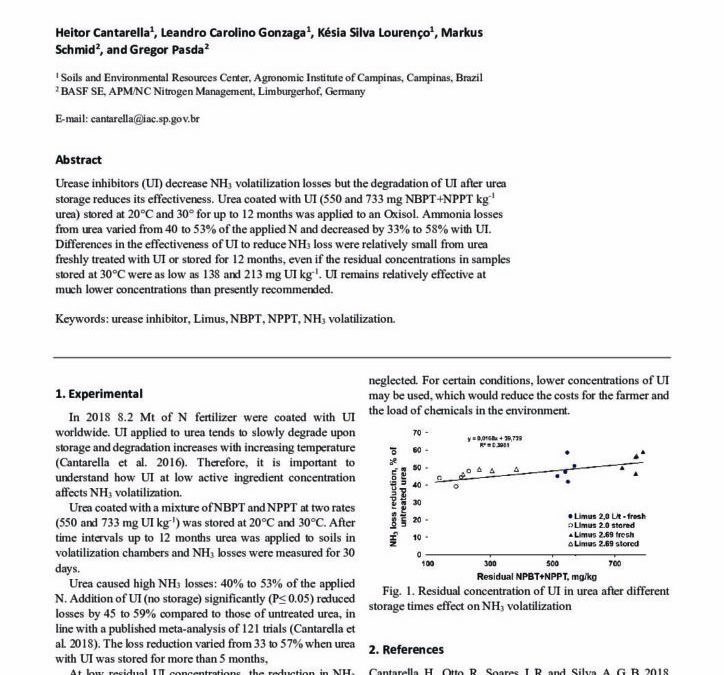
Urease inhibitor still active at low concentration
Urease inhibitors (UI) decrease NH3 volatilization losses but the degradation of UI after urea storage reduces its effectiveness. Urea coated with UI (550 and 733 mg NBPT+NPPT kg-1 urea) stored at 20°C and 30° for up to 12 months was applied to an Oxisol. Ammonia...
Effect of urease and nitrification inhibitors on N2O emissions, ammonia volatilization and crop yield in a rape crop
A field experiment was conducted in an Oilseed rape (Brassica napus L.) crop in central Spain. We evaluated three different fertilizer treatments: conventional fertilizer (urea), fertilizer with urease inhibitor and fertilizer with urease and nitrification inhibitors....

Effect of application rate on nitrogen fertilizer recovery in an irrigated cotton cropping system
Irrigated cotton in Australia on heavy textured clay soils (Vertiol) is typically described as inefficient with respect to nitrogen, due largely to significant gaseous N losses through denitrification. We investigated the effect of different N rates (100N, 200N, 300N)...
Effects from plant type and glyphosate application on mineralization of nitrogen from catch crops
Plant residue decomposition plays a vital role in soil fertility and nitrogen leaching in agriculture, especially in connection with the use of catch crops between main crops. A low temperature incubation experiment was carried out using three types of catch crops (a...

Nitrogen use efficiency of maize and cotton in 1.32 Mha of commercial farms in Brazil
We used data from 2011 to 2019 of cotton and maize yields and N fertilization of 4,519 commercial fields covering 1.32 Mha in Brazil to calculate nitrogen use efficiency (NUE), N export with grains and lint+seeds, and N surplus. Despite the wide variations expected in...

Indices of crop water stress from UAV images precisely map residual nitrogen
The risk of nutrient losses in production of vegetables and early potatoes under irrigation is increased by significant spatial variability of soil water capacity and infiltration rate of fields. The impact of water stress on not irrigated crops, occasionally grown on...