
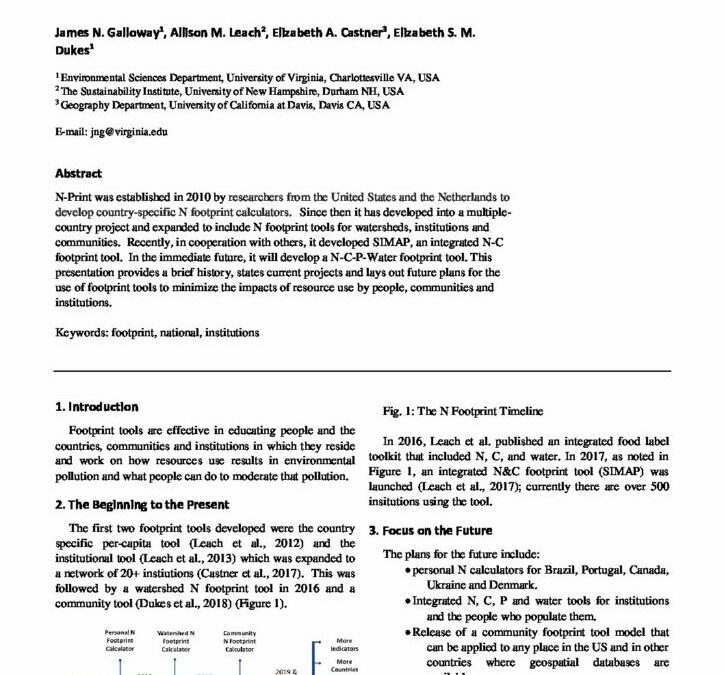
Expanding the Nitrogen Footprint Pathway
N-Print was established in 2010 by researchers from the United States and the Netherlands to develop country-specific N footprint calculators. Since then it has developed into a multiplecountry project and expanded to include N footprint tools for watersheds,...
The N-Footprint of the agricultural research station at Aarhus University in Denmark utilizing an N-Institution calculator
The exponential use of reactive nitrogen and it’s dramatic increased usage in the 20th century, has led to negative cascading environmental effects that need to be identified and quantified. The N-Footprint is a calculation tool that has been designed to quantify the...
Nitrogen-neutrality fosters more sustainable meetings
UN Climate Conference COP24 in 2018 (Katowice, Poland) has been criticized for its meat (and emissions) heavy menu as the scientists are expected to act in accordance with their understanding of the science. N-neutrality has been proposed and applied when organizing...

Trends in the food nitrogen and phosphorus footprints for China, India, and Japan
Abstract The environmental damage resulting from the loss of nitrogen (N) and phosphorus (P) input during food production to the environment is significant. We developed a common framework to allow a comparative evaluation of nutrient footprints and applied it to the...

Input-output analysis of reactive nitrogen flows in industry and industrial nitrogen footprint
Various nitrogen (N) compounds, collectively called reactive nitrogen (Nr) in industry, account for considerable proportions in the global N cycle. Complication of the interactions between the industrial sectors has hindered our understanding of their dynamics. We...

Towards a practical environmental footprint tool
The Integrated Environmental Footprint Tool (IEFT) has four linked sub-modules for N, C, P and water. The IEFT will be applied specifically to sustainability assessment in institutions of higher education because campuses provide an ideal setting for assessing,...
How Germany’s national air pollution control programme contributes to reduced emissions of reactive nitrogen into the atmosphere
Directive (EU) 2016/2284 on the reduction of national emissions of certain atmospheric pollutants (new NEC Directive) establishes emission reduction commitments for national emissions of all member states. Member states also have to draw up national air pollution...

The Dutch integrated approach to monitor and calculate nitrogen deposition in Natura 2000 areas
The Netherlands have developed a tool to monitor the nitrogen deposition in Natura 2000 areas, called AERIUS. With the same tool, the impact of individual projects on the nitrogen deposition in Natura 2000 areas can be calculated. The tool accounts for both nitrogen...
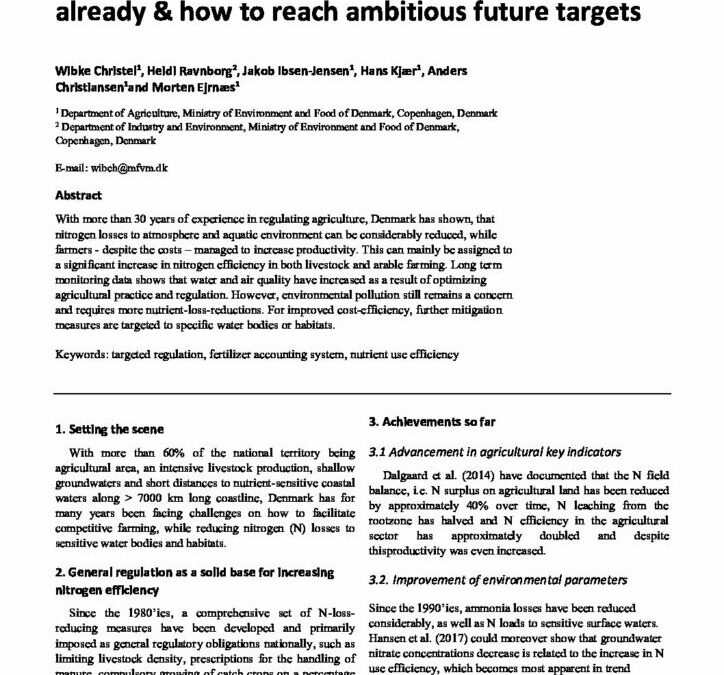
How Danish farmers have doubled N efficiency already & how to reach ambitious future targets
With more than 30 years of experience in regulating agriculture, Denmark has shown, that nitrogen losses to atmosphere and aquatic environment can be considerably reduced, while farmers - despite the costs – managed to increase productivity. This can mainly be...
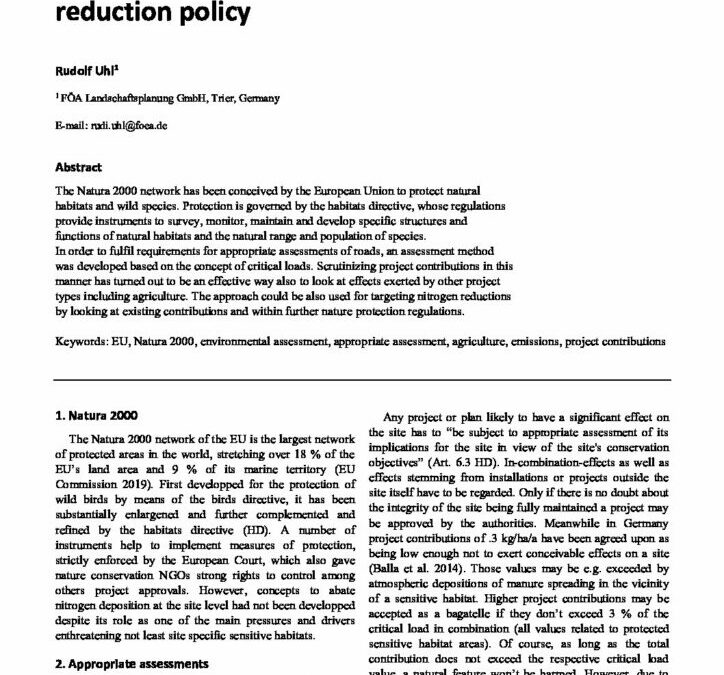
Natura 2000 as a strategic element of nitrogen reduction policy
The Natura 2000 network has been conceived by the European Union to protect natural habitats and wild species. Protection is governed by the habitats directive, whose regulations provide instruments to survey, monitor, maintain and develop specific structures and...